1. The Chokepoint of the World: Why the Strait of Hormuz Matters
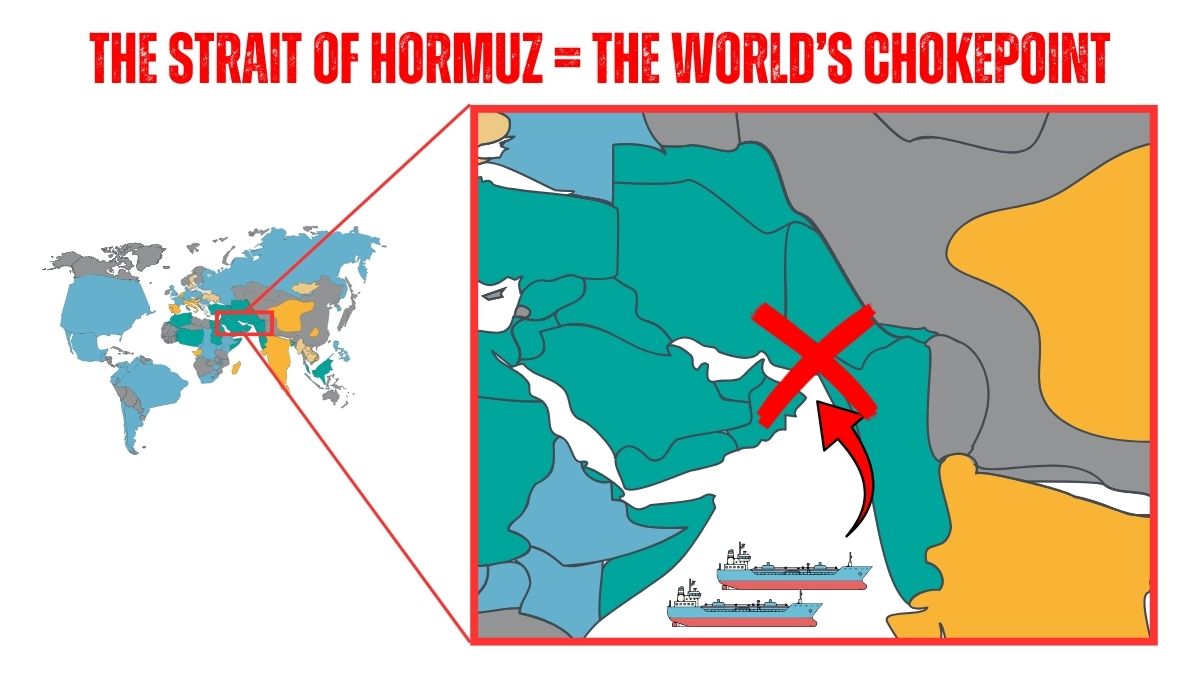
In the global energy system, the Strait of Hormuz is widely considered the world’s most critical oil chokepoint.
Based on 2024 estimates, roughly 20 million barrels per day (b/d) of oil transit this narrow strait—about 20% of global petroleum liquids consumption. If this artery were blocked, or if tensions between the United States and Iran escalated sharply, the shock to oil markets and transportation costs could be immediate and severe.
This is not a distant geopolitical issue. It directly affects Asian economies. In 2024, approximately 84% of crude oil and 83% of LNG moving through the strait were destined for Asian markets such as Japan, China, and South Korea. Much of Asia’s energy security effectively passes through these waters each day.
If military conflict were to occur, Iran’s ability to threaten shipping—through mines, anti-ship missiles, drones, and fast-attack craft—could raise the risk of temporary restrictions, convoy requirements, and war-risk surcharges even without a full blockade. During the 1980s “Tanker War,” hundreds of merchant vessels were attacked or damaged, and risk perception alone significantly increased insurance costs and freight rates. The lesson is clear: pricing risk can move faster than physical supply.
2. How High Could Oil Prices Rise? The Geopolitical Risk Factor
A U.S. strike on Iran could trigger a two-stage market response:
- an initial spike driven by geopolitical risk premiums and fear
- a second surge if physical supply disruptions follow
In mid-February 2026, WTI crude traded at its highest level in roughly six months, in the mid-$60s per barrel, as tensions rose. While markets often anticipate softer prices during oversupply cycles, conflict changes the risk calculus rapidly.
If a major confrontation were to occur, prices could plausibly spike above $100—particularly if supply flows were visibly threatened. Reaching inflation-adjusted levels near $150 would likely require sustained physical disruption combined with limited spare production capacity.
Table 1: Geopolitical Events and Oil Price Context (Illustrative)
| Period | Event | Oil Price Context | Market Effect |
|---|---|---|---|
| Nov 2023 | Red Sea shipping attacks | ~$80 range | Initial risk premium |
| Nov 2024 | Oversupply concerns | Below $70 | Downward pressure |
| Jun 2025 | Israel–Iran tension | ~$70–80 range | Risk premium returns |
| Feb 2026 | U.S.–Iran tensions rise | Mid-$60s | Technical + geopolitical support |
| Conflict scenario | Hormuz disruption risk | $100–150 (range) | Panic buying / supply fear |
Rising crude prices typically feed into bunker fuel costs, though the pass-through is not one-to-one. The relationship depends on refining spreads, fuel grades (e.g., VLSFO), and regional supply conditions. Fuel costs should therefore be treated as a range rather than a fixed formula.
3. Why Shipping Rates Rise During Conflict
Shipping costs tend to move through several channels simultaneously. A simplified framework is:
Freight ≈ Base rate + Fuel surcharge (BAF) + War-risk surcharge + Market imbalance premiums
Short-term volatility usually comes from fuel prices, risk premiums, and vessel availability rather than fixed operating costs.
3.1 Fuel Costs and Bunker Adjustment Factors (BAF)
Fuel often represents a major share of voyage cost, though the proportion varies by vessel type, speed, route length, and fuel grade. To manage this volatility, carriers apply Bunker Adjustment Factors (BAF) tied to benchmark fuel indices and trade-lane formulas.
Table 2: Example Fuel Cost Influence on Freight (Illustrative)
| Fuel Trend | Expected Freight Impact |
|---|---|
| Stable fuel prices | Limited rate movement |
| Rapid fuel rise | BAF surcharges increase |
| Volatile fuel market | Contract renegotiation risk |
Numeric BAF examples should always be supported by carrier notices or contract terms.
3.2 War-Risk Premiums
During conflict, parts of the Persian Gulf may be designated higher-risk insurance zones. War-risk premiums can rise sharply depending on the vessel, route, and underwriter. Recent maritime crises show that insurance quotes can increase dramatically once a region is perceived as unsafe.
3.3 Throughput Loss vs. Rerouting
If the Strait of Hormuz were physically blocked, the core issue would not be longer transit routes—it would be the inability of vessels to exit the Persian Gulf at all.
Some export volumes could theoretically be diverted through pipelines to Red Sea or Mediterranean terminals, but these routes have limited capacity and cannot fully replace Hormuz throughput.
Even partial restrictions could still push freight rates higher through:
- convoy scheduling delays
- risk surcharges
- tighter vessel availability
- port congestion
4. Sector-Specific Impacts
Oil Tankers
Tankers typically react first to geopolitical risk. Spot rates for large crude carriers can surge rapidly as war-risk premiums are priced in.
Container Shipping
Fuel surcharges may lag initially, but schedule disruption, convoy routing, or port congestion can trigger secondary rate increases.
RoRo / Car Carriers
Car carrier routes serving the Middle East may face additional fuel, insurance, and security surcharges depending on conditions.
Table 3: Illustrative Car Shipping Cost Structure (Japan → Middle East)
| Cost Element | Typical Range (USD) | Notes |
|---|---|---|
| Base freight | $800–1,600 | Carrier-dependent |
| Port handling & duties | $400–1,000 | Includes import charges |
| Conflict-related surcharges | Variable | Fuel / risk / congestion |
| Total landed cost | $1,300–3,000+ | Highly scenario-dependent |
5. Three Possible Conflict Scenarios
Scenario A: Limited Strike
Oil: $80–90
Freight: Tanker rates rise 50–100%, emergency surcharges appear
Scenario B: Prolonged Regional Conflict
Oil: $100–120
Freight: Tanker rates may surge 3–4x; widespread disruption lifts costs across shipping segments
Scenario C: Full Hormuz Blockade
Oil: $150–200 (extreme scenario)
Freight: Physical throughput collapses; markets become illiquid and price signals unreliable
6. Preparing for a High-Risk Shipping Environment
Rising transport costs eventually translate into inflation across economies. Some countries have explored diversification strategies—such as pipelines or alternative import routes—to reduce chokepoint exposure. However, these are partial mitigations, not substitutes for Hormuz volumes.
Three practical business strategies:
1. Build cost-pass-through mechanisms
Ensure contracts allow rapid adjustment for fuel and insurance changes.
2. Increase operational buffers
Plan for schedule disruption rather than assuming just-in-time reliability.
3. Diversify logistics hubs where feasible
Spreading routing risk can reduce vulnerability to single-point disruptions.
Final Thought
In today’s geopolitical environment, shipping costs are no longer driven only by supply and demand. Strategic chokepoints, security risks, and energy dependencies now play a direct role in logistics pricing.
For companies dependent on global trade, the ability to anticipate these risks is no longer optional—it is essential.
Sources
Amid regional conflict, the Strait of Hormuz remains critical oil artery – EIA
https://www.eia.gov/todayinenergy/detail.php?id=65504Crude Oil – Price – Chart – Historical Data – News – Trading Economics
https://tradingeconomics.com/commodity/crude-oilBunker Adjustment Factor (BAF) – Maersk
https://www.maersk.com/news/articles/2023/12/01/bunker-adjustment-factorBunker Adjustment Factor (BAF) – Maersk
https://www.maersk.com/news/articles/2024/09/02/bunker-adjustment-factorBunker Adjustment Factor (BAF) – Maersk
https://www.maersk.com/news/articles/2025/09/01/bunker-adjustment-factorWar Risk Premiums Surge Amid Renewed Red Sea Attacks – gCaptain
https://gcaptain.com/war-risk-premiums-surge-amid-renewed-red-sea-attacksWar Risk Premiums Surge Amid Renewed Red Sea Attacks – gCaptain
https://gcaptain.com/war-risk-premiums-surge-amid-renewed-red-sea-attacksTanker U-turns on the rise in Strait of Hormuz as analysts eye trade shifts – Riviera
https://www.rivieramm.com/news-content-hub/news-content-hub/tanker-u-turns-from-strait-of-hormuz[2025 Edition] The Complete Guide to Used Car Exports in the UAE – Japan Carrier
https://japan-carrier.com/post/2025-edition-the-complete-guide-to-used-car-exports-in-the-uae[2025 Edition] The Complete Guide to Used Car Exports in the UAE – Japan Carrier
https://japan-carrier.com/post/2025-edition-the-complete-guide-to-used-car-exports-in-the-uaeRoRo Shipping Rate Increase: What Exporters Should Know – WC Shipping
https://wcshipping.com/blog/roro-shipping-rate-increase-what-exporters-should-knowStrait of Hormuz – Tanker War – The Strauss Center
https://www.strausscenter.org/strait-of-hormuz-tanker-war

Are you searching for the most reliable, efficient, and hassle-free way to import cars from Japan?
Partner with us and enjoy smooth, stress-free results!
- Absolutely FREE to get started
- Browse at your leisure
- Your information is 100% secure
no fees, no spam, just smooth car imports!